
St. Albans, Charleston WV
Garage Door Repair for St. Albans, WV Homes
St. Albans homes mostly date to 1956, older than much of the wider Charleston service area. We fix torsion springs, openers, and tracks on that older stock, driving in from Charleston, 10 miles out.
Local detail
What We Do Not Do
We run out of Charleston, not out of a shop in St. Albans, so we don't promise a same-day window before we've talked to you about the actual problem - a bent track needs a different truck load than a snapped cable. We don't carry every obsolete part for a door old enough to have started life on the original hardware; if a panel or a spring size was discontinued decades ago, we'll tell you that up front instead of stringing you along with a part that's "on its way." We also don't do new-construction framing or structural work on the opening itself - we work on the door, the opener, and the track system, not the header or the studs around it.
And we won't quote a repair over the phone sight unseen when the door's old enough that we can't be sure what's behind the bottom bracket until we're standing in front of it. That's not evasiveness, it's what almost forty years of housing variation across this area actually requires.
The area
What Was Built Here
St. Albans skews older than the service area as a whole. The median year built here runs to about 1956, while the broader coverage area - 34,040 households across eighteen named communities - has a median closer to 1967, with homes going up anywhere from 1949 to 1993. That decade of difference matters on a garage door.
A house built in the mid-1950s was more likely fitted with an extension-spring setup mounted along the horizontal track rather than a torsion spring over the header, and the door itself is more likely a heavier, uninsulated steel or wood panel than the lighter sandwich-panel doors that came standard once torsion systems and insulated cores became common in the 1970s and after. With roughly 4,715 households in St. Albans, a meaningful share of the doors in town are still running on that original-era hardware, or a replacement door bolted onto original-era track and jamb hardware nobody updated when the door itself was swapped.
What we find
When We Can Get There
St. Albans sits about 10 miles from our base in Charleston - one of the shorter drives on our route, closer than places like Cross Lanes, Elkview, or Winfield further out. We don't advertise a fixed arrival time because that number depends on where the truck already is and what the job ahead of yours turns out to be, but the distance itself isn't the limiting factor here the way it can be for the towns fourteen, seventeen, or eighteen miles out.
The service area sits in a cold-moderate climate band, which mostly shows up as a scheduling factor in winter: a spring that's already worn tends to fail on the first hard cold snap, so calls cluster after a cold front rather than spreading evenly through the year. If your opener's been making a delayed click before it lifts, or your door's been dropping half an inch and catching, that's usually a spring losing tension gradually - worth a call before it lets go completely and the door comes down on its own.
How we work
How That Shows Up in the Door
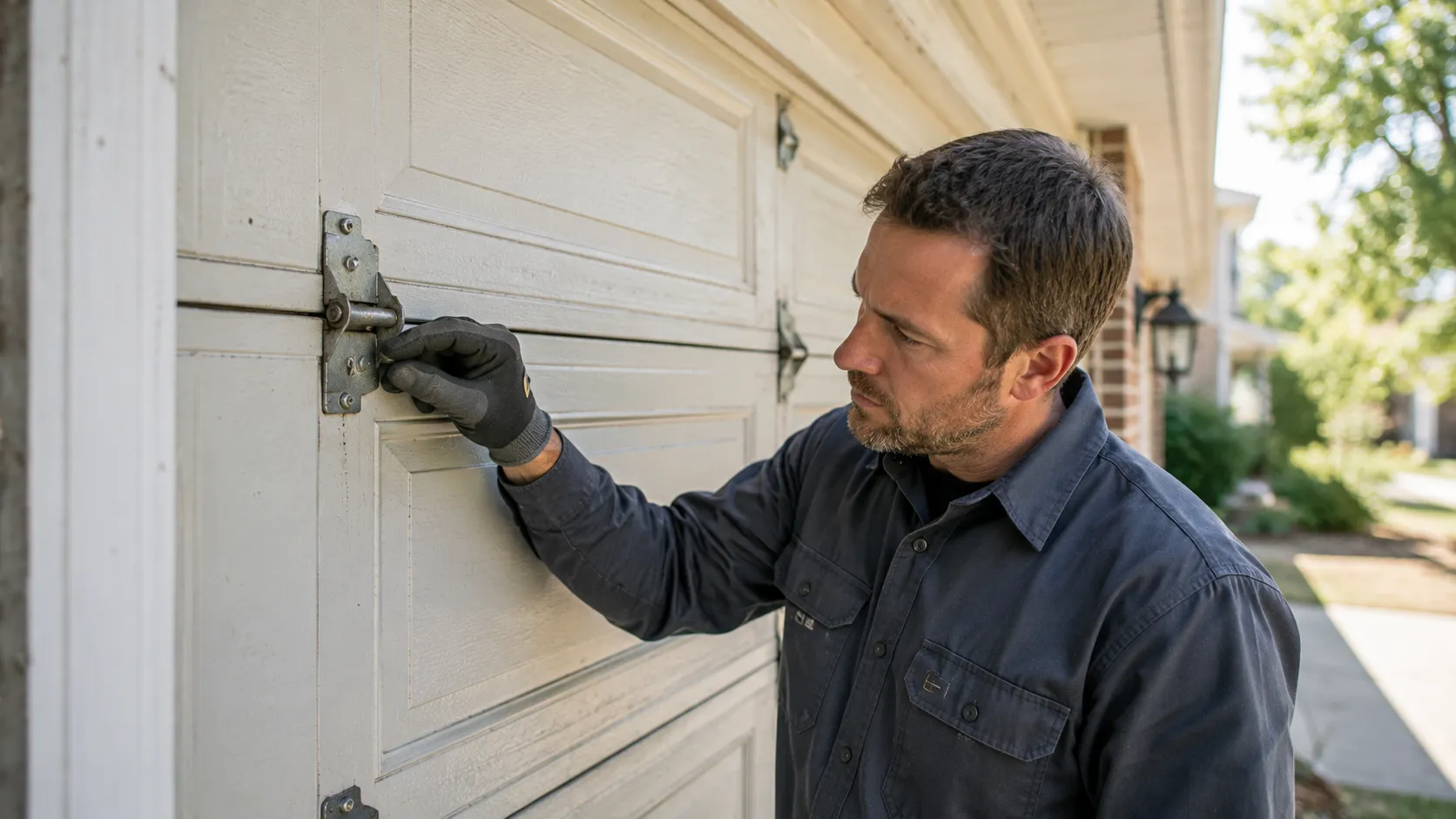
On a door dating to the 1956-era stock common in St. Albans, the failure pattern is different from what you'd see on a house built in the 1970s or later. Extension springs on older track systems stretch and fatigue differently than torsion springs, and they're mounted in a spot where a snapped one can whip the cable rather than just dropping the door - it's a job we treat with more care, not less. Steel panels from that era also weren't insulated the way current doors are, so if the door's original, you'll feel more cold coming off it in winter and hear more rattle in the track before you feel a mechanical fault at all.
Rollers on original hardware are often the plain steel type rather than nylon, which means more noise and faster wear at the hinges. None of this means the door needs replacing - a lot of these openings run fine for years on serviced original hardware - but it does mean a repair call on a St. Albans door built in that window often turns into a hardware assessment first, not just a spring swap.
 20 areas covered
Service areas
Other areas we cover near St. Albans
Questions
Common questions
Is my garage door too old to repair instead of replace?
Not necessarily. A lot of doors from the 1950s and 60s run fine once the spring, cable, and rollers are serviced or matched to what's actually on the track. Replacement makes more sense when the panel itself is rusted through or badly bent, not just because the door is old.
Do you have a shop in St. Albans?
No. We're based in Charleston, about 10 miles away, and we drive out to St. Albans as part of our regular coverage area. We don't keep a local depot here, so we schedule based on the job and where the truck already is that day.
Why does my old extension-spring door behave differently than newer torsion doors?
Extension springs stretch along the horizontal track instead of twisting over the header, so they wear and fail differently - often with more visible sag before a full break, and a whip risk in the cable when they go. Older track hardware also tends to be noisier as it wears.
Ready when you are
Need a garage door sorted in Charleston?
Charleston Garage Door Pros repairs and installs garage doors, springs and openers in Charleston, WV and the surrounding area.