
Guide
What That Noise in Your Garage Door Is Trying to Tell You
Charleston homes built mostly 1949-1993 carry original hardware prone to specific sounds. Here's what each noise means and when to worry, from a local garage door crew.
Local detail
What Local Conditions Do
Most houses across this part of the Kanawha Valley went up between 1949 and 1993, with the bulk of that stock dating to the 1960s and 70s. That matters for noise because a door installed on a house built in, say, 1967 has had five and a half decades of seasonal swings to work springs loose, dry out rollers, and shift track brackets that were only ever lag-bolted into aging jamb wood. Charleston sits in a cold-moderate climate band, not the deep freeze of the upper Midwest, but enough temperature swing between summer humidity and winter cold to expand and contract steel track and door panels every year.
That cycling is slow and it's cumulative. A door that was dead silent in July can pick up a squeak or a thunk by January, not because anything broke overnight, but because a fastener that was already borderline finally worked loose. On the original torsion hardware still common in this housing stock, that shows up as noise well before it shows up as a failure you can see.
The area
Where People Go Wrong
The most common mistake in houses from this 1960s-70s era is treating every noise the same way: a shot of WD-40 and move on. That works for exactly one kind of sound - a dry roller or hinge squeak - and does nothing for the two noises that actually matter, a loose track bracket and a spring under uneven tension. Because so much of the area's housing shares the same age and the same original hardware, we see the same pattern house after house: someone lubricates the noisy spot, the sound goes quiet for a few weeks, and then it comes back louder because the underlying fastener or spring wasn't touched.
The other common error is ignoring a noise that only happens once or twice a month. On a door this old, an intermittent bang or pop is often the cable or spring finally reaching the end of its working life, not a fluke.
What we find
What to Check
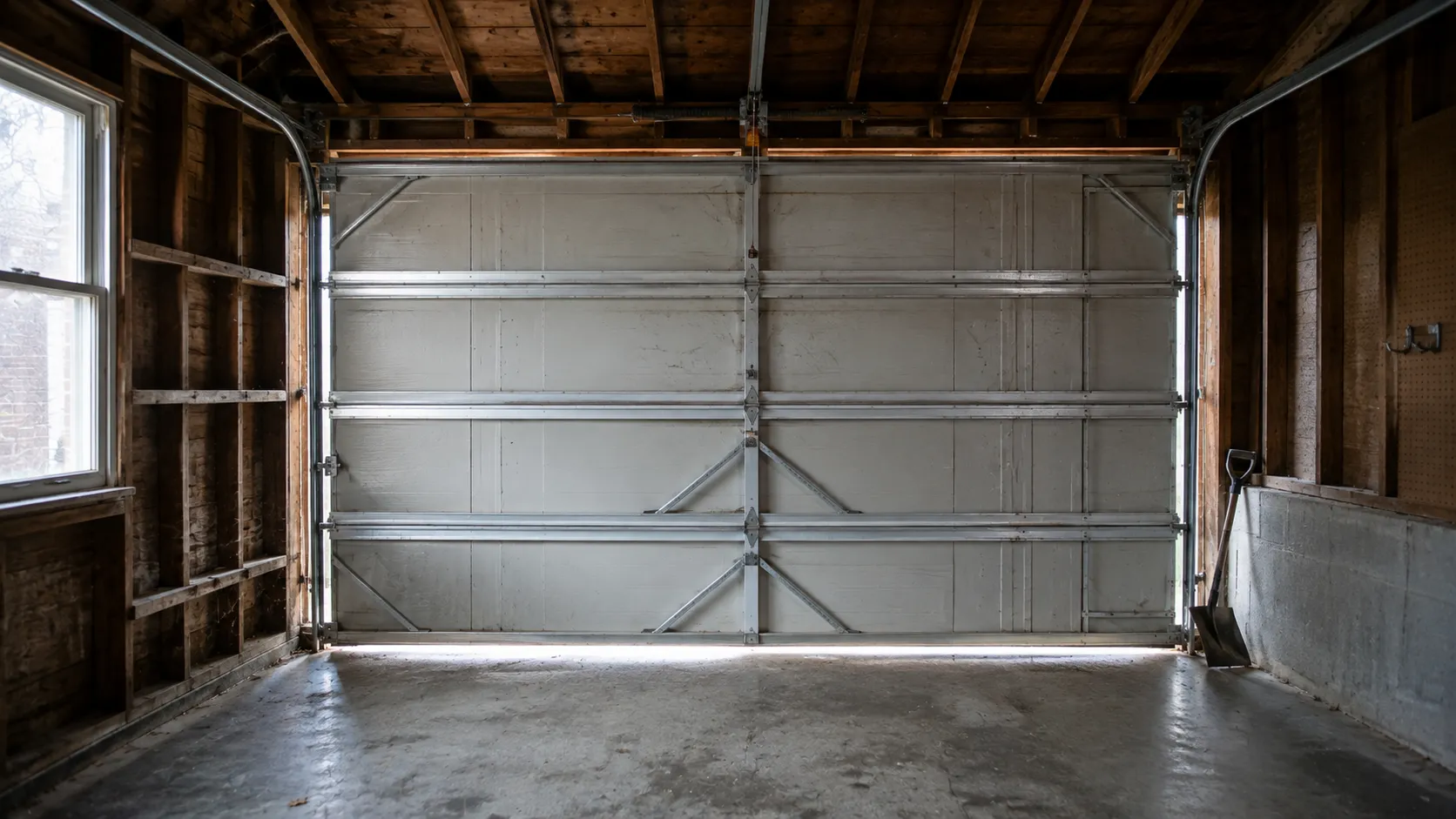
Start with where the noise happens in the door's travel. A squeak at the very top or bottom of the cycle usually points to a roller or hinge that needs grease, not replacement. A loud bang partway through the cycle, especially near the middle, is more often a torsion spring or a cable under stress - on hardware installed decades ago, that's the kind of noise that precedes a full spring failure.
Rattling that seems to come from the wall, not the door itself, usually means a bracket has worked loose from the framing, which is common once lag screws in older jamb lumber have had fifty-plus years to loosen with wood movement. Grinding or scraping almost always means the track is out of alignment, which on a door this age can also mean the track itself has bent slightly from years of thermal cycling. If you can't tell which of these you're hearing, that's reasonable - some of these sounds overlap, and telling a bad roller from an early spring failure by ear alone isn't always possible.
How we work
The Situation
Here's the honest limit: we can't diagnose a spring failure over the phone from a description of a noise. What we can say is that in a service area where the median home dates to 1967, a good share of the doors we look at still have original or near-original hardware, and noise is usually the last warning before something lets go rather than the first sign of it. If your door is quiet, that's not proof everything's fine - some of the worst spring failures happen with no warning noise at all.
If it's loud, don't keep opening and closing it hoping the sound fixes itself. We're not going to tell you every noise needs a truck out - a squeaky hinge doesn't - but a bang, a grind, or a new rattle on a door this old is worth a look before it becomes a door that won't open at all.
Questions
Common questions
My garage door started banging loudly out of nowhere - is that an emergency?
On hardware this old, a sudden bang partway through the door's cycle is often a torsion spring reaching failure. It's not always an emergency, but it's not something to keep using either. Stop operating the door until it's checked - a spring that lets go while the door is opening can cause real damage.
Why does my door only make noise in winter?
Charleston's climate band cycles between summer humidity and winter cold every year, which expands and contracts steel track and fasteners. On houses from the 1960s and 70s, that seasonal movement is often enough to loosen a bracket or bind a roller that was fine all summer.
Is it normal for an older door to be a little noisy?
Some noise is normal on hardware this old - a light squeak from a dry roller isn't cause for alarm. What's not normal is a new bang, grind, or rattle that wasn't there before. That kind of change usually means something has shifted or is close to failing.
Can I just lubricate everything and call it fixed?
Lubrication fixes dry rollers and hinges, nothing else. It won't fix a loose bracket, a bent track, or a spring under uneven tension, and spraying oil on those can mask a noise that was warning you about something more serious.
Ready when you are
Need a garage door sorted in Charleston?
Charleston Garage Door Pros repairs and installs garage doors, springs and openers in Charleston, WV and the surrounding area.